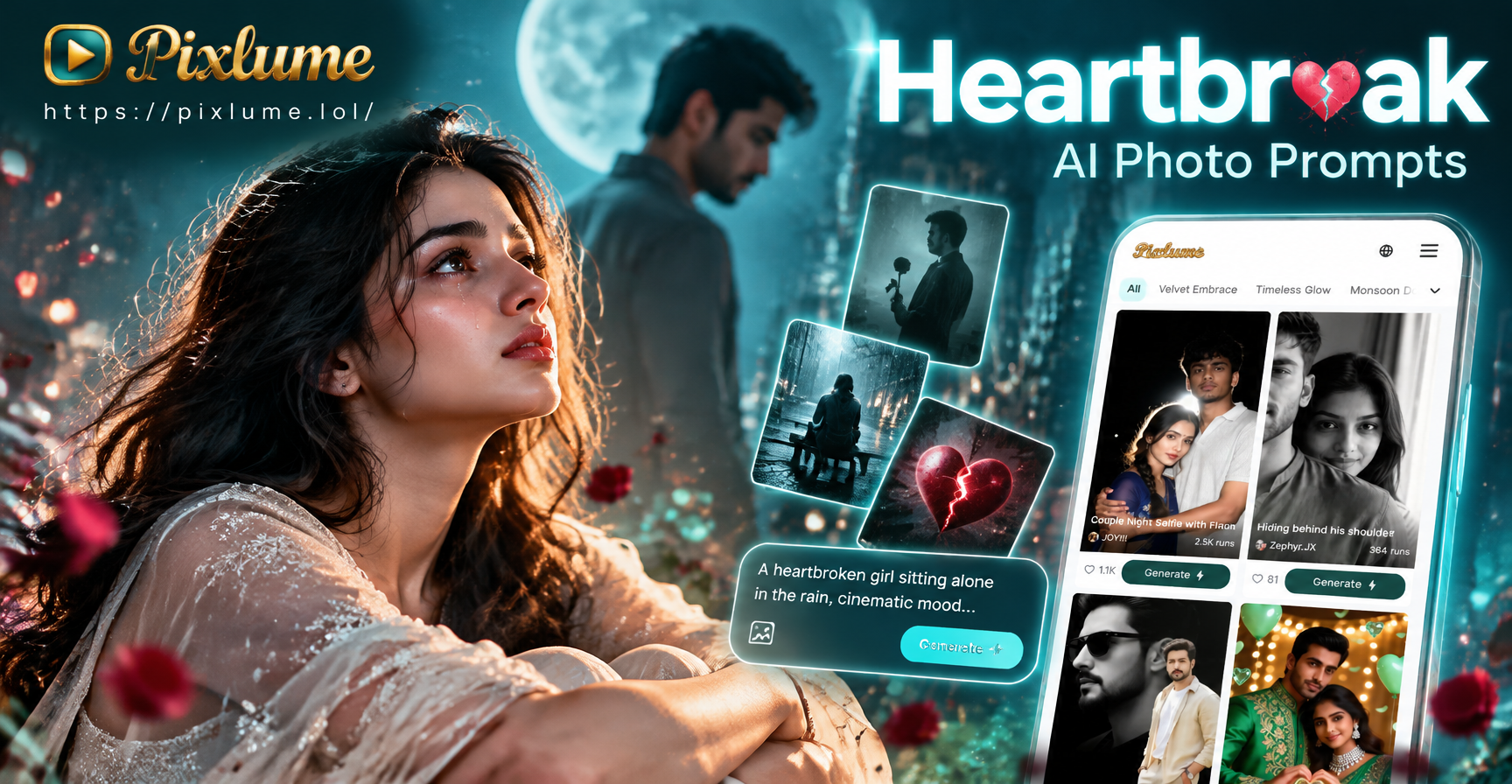
Why These Heartbreak AI Photo Prompts Work
Heartbreak is a powerful visual subject, but it is easy to fall into clichés. A crying figure alone is not enough to create a memorable image. The best heartbreak AI photo prompts combine an emotion with a place, an object, and a specific light. They use cinematic language like close up, wide shot, film grain, and shallow depth of field. This article gives you a complete set of heartbreak AI photo prompts that you can paste directly into pixlume. Each prompt is ready to use on its own, and each one can be adapted to your own story.
When you use a specific prompt, the AI model can focus on a clear scene instead of guessing what heartbreak looks like. For example, a prompt like sad woman in a room is too open. The AI might generate a generic portrait with a slight frown. But a prompt like a woman by a rain streaked window, one tear on her cheek, cold blue light, empty cup on the sill gives the model concrete visual instructions. The difference is visible in the final image.
20 Heartbreak AI Photo Prompts You Can Use Right Now
Below are 20 prompts grouped by mood. In the pixlume app, open Text to Image, paste one prompt, then choose a style filter such as Cinematic, Film Photography, Black and White, or Watercolor. Generate a few versions and keep the one that feels right.
Rainy Night Heartbreak Prompts
- A close up of a woman by a rain streaked window, soft blue light, one tear on her cheek, cinematic, shallow depth of field, film grain
- A man sitting on the floor of an empty apartment at night, one small lamp, long shadows, cold silence, photorealistic, muted colors
- A hand letting go of a red string in the rain, dark background, high contrast, symbolic heartbreak, cinematic
- A reflection in a puddle of a couple from better days, now one person's reflection fading, night city lights
Rainy night prompts work because rain instantly adds texture, reflection, and a sense of isolation. Keep the light cool and the background simple so the subject does not get lost.
Empty Space and Loneliness Prompts
- An empty park bench under a leafless tree, overcast sky, one red balloon caught in the branches
- An abandoned hallway with closed doors, dramatic light from under one door, a person looking back, cinematic wide shot
- A child's swing swaying in an empty park, thick fog, muted tones, no people
- A long exposure of a train leaving a platform, motion blur, one person still standing, night, lonely atmosphere
Empty space prompts use negative space to communicate absence. You do not always need a face. A room, a chair, or a swing can tell the story. Add one unexpected detail, like the red balloon, to keep the image from feeling empty in a dull way.
Silhouette and Symbol Prompts
- A silhouette of a person walking away on a foggy bridge, monochrome, long coat, empty road, cinematic
- A broken heart shape made of cracked glass on wet asphalt, neon reflections at night
- A woman in a white dress standing in a field at dusk, wind moving her hair across her face, melancholic
- A close up of fingers releasing a dandelion seed, the seeds turning into small birds, symbolic healing
Silhouettes reduce identity and focus on posture and movement. Symbol prompts use objects to stand in for emotion. Choose symbols that are personal but still universally readable, like a red string, a broken heart, or a floating seed.
Nostalgic Memory Prompts
- A polaroid photo lying on a wooden table, edges burnt, two faded silhouettes, dusty window light
- A torn movie ticket and dried rose petals on a scratched wooden desk, soft light, nostalgic sadness
- An old vinyl record spinning on a turntable, dust in sunlight, empty living room, warm but sad
- A watch with a cracked face and frozen hands, lying on a handwritten letter, soft candlelight
Nostalgic prompts rely on objects that carry memory. The object should feel old, worn, or slightly damaged. Use warm but faded light, like dust in a sunbeam, to suggest a memory that is already fading.
Healing and Letting Go Prompts
- A burning love letter in a metal wastebasket, smoke curling, dark room, dramatic light
- A girl hugging her knees on a bed surrounded by old letters, warm but sad, muted tones
- A close up of two coffee cups, one full and one cold with a lipstick stain, morning light, empty chair opposite
- A sunrise over an empty road, a backpack on the ground, one person walking toward the light, hopeful recovery
Healing prompts show heartbreak moving toward acceptance. The light becomes warmer or brighter, and the subject is often in motion. Include the remnants of the past, like the empty chair or the old letters, to show what was left behind.
To adapt any prompt, replace the subject, the location, or the object. For example, change a woman by a window to a man on a balcony. Change rain to snow. Change the red string to a tarnished ring. Keep the light, camera language, and mood words so the result stays consistent.
How to Write Your Own Heartbreak AI Photo Prompts
You can create original heartbreak prompts by combining five elements: emotion, subject, scene, light, and symbolic detail. Start with an emotion such as longing, regret, numbness, or quiet acceptance. Then add a subject, like a person or only their belongings. Add a scene that feels lonely or familiar. Choose light that reinforces the mood, such as cold blue, warm candlelight, or overcast gray. Finally add one symbolic object that carries the story. This method gives the AI enough visual direction without writing a long paragraph.
Here are three original prompts built this way:
- A single white envelope with no sender name on an empty kitchen table, cold morning light, photorealistic, quiet longing
- An old jacket hanging on a chair by an unmade bed, evening shadows, muted colors, the feeling of absence
- A bookstore window seen from outside, rain on glass, two blurred figures inside, one looking toward the door, cinematic
When you adapt a prompt, keep the structure intact. For example, a preset like a subject, a scene, a light source, and a mood word will almost always produce a stronger image than a fragment. You can also use Image to Image in pixlume if you want the AI to keep your original photo but add rain, fog, tears, or a symbolic object.
Using pixlume to Generate Heartbreak AI Photos
pixlume is a mobile app that turns text prompts into high quality images. To use these heartbreak AI photo prompts, download pixlume from Google Play, open the app, and select Text to Image. Paste a prompt, then choose a style filter. For heartbreak themes, the Cinematic and Film Photography filters work well for realistic moody images. Black and White or Watercolor filters give a more artistic, emotional feel. You can also use Image to Image if you already have a photo of a person or a place and want the AI to add rain, fog, or a symbolic object while keeping the original subject. Generate several versions and download the ones that match your vision.
Because pixlume offers more than one million style filters, you can test different moods quickly. A rainy street prompt can look like a noir film with the Black and White filter, or like a dreamy painting with the Watercolor filter. Try a few combinations before choosing your final image.
Common Weak Results and Quick Fixes
A weak heartbreak AI image usually shows a person crying with no context, or a scene that looks too clean and cheerful. If your result feels generic, add one or two of these fix words to your prompt: moody, muted colors, negative space, no smile, film grain, overcast, or dramatic light. If the image is too busy, add the phrase wide shot or empty background. If the face shows the wrong emotion, add the phrase neutral expression or distant gaze. Avoid prompts that only describe an emotion without a scene. For example, a prompt like sad girl in a room is weak. A prompt like a girl sitting on a bare mattress in a gray room, rain on the window, one suitcase by the door, muted tones is much stronger.
Another common issue is glossy skin or perfect lighting that looks like an ad. To avoid this, add words like film grain, old photograph, or natural light. If you want a rawer look, use prompt terms like gritty, desaturated, or candid. These small changes help the result feel more like a real memory and less like a stock photo.
Start Creating Heartbreak AI Photos Today
Heartbreak AI photo prompts help you turn a difficult feeling into a powerful image. Whether you want a rainy night portrait, an empty room, or a symbolic object, the prompts in this guide are ready to use. Download pixlume, pick a prompt, choose a style, and generate your own emotional visuals.